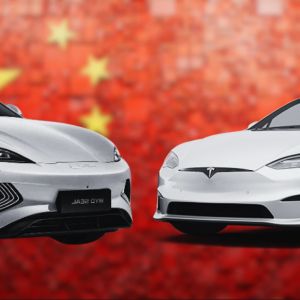
China’s electric vehicle market is no longer exploding, it’s tightening. The gold rush is fading, and automakers are being dragged into a brutal fight to survive. In 2025, both Tesla and BYD posted lower sales, with Tesla down 7.4% and BYD falling 5.1% from the year before. The drop got uglier in November, when BYD’s numbers collapsed by 26.5%. And while they stumbled, the flashy newcomers, including cars backed by Huawei and Xiaomi, took off with sales growth above 90%. But the old darlings aren’t the only ones sweating. Those early U.S.-listed names (Nio, Xpeng, and Li Auto) didn’t even crack the top 10 sellers, even though they’ve been improving monthly delivery numbers. It didn’t matter. This is no longer a market where every player wins just by showing up. Chinese market gets more crowded as discounts explode There’s no more room for small talk. The market is now concentrated at the top. Xiao Feng, co-head of China Industrial Research at Citic CLSA, said the top ten makers now hold 95% of the new energy vehicle space, compared to just 60% to 70% a few years ago. And that space includes both hybrids and battery electrics. Autohome, a local car listing platform, is showing huge markdowns, with 432,000 yuan off the Mercedes-Benz EQS EV and 147,000 yuan sliced off the Volvo XC70. Paul Gong, who heads China autos research at UBS, said this knife fight isn’t ending soon. “The price war could last for years,” he said. And just when you think things can’t get worse, Beijing shows up with new tax policies. Purchase tax is coming back. Trade-in subsidies are getting cut. UBS says the EV sales growth rate will likely fall by half next year, from around 20% in 2025. The market’s stuffed to the brim already. New energy vehicles made up 59.4% of new passenger car sales in November, according to the China Passenger Car Association. That’s a warning light, not a trophy. Chinese EV makers are pushing overseas as home market turns cold With fewer buyers at home, China’s EV makers are rushing abroad.Geely, based in Hangzhou, said its electric car exports quadrupled in the first half of the year. It shipped 184,000 vehicles, launched in six new countries, and now has a footprint in around 90 markets. Geely also opened factories in Egypt, the Middle East, and Indonesia. Right now, it’s second only to BYD in local EV sales. BYD is stretching out, too. The company exported over 131,000 cars in November, and its Hungary factory is expected to ramp up by 2026. Tu Le, managing director at Sino Auto, said Chinese companies and battery makers will “firmly stake their claims in Europe.” They’re not stopping at Berlin. They’re eyeing Detroit, too. Foreign automakers aren’t walking away from China either. Volkswagen is going all in.It set up joint ventures with Xpeng and Horizon Robotics, and its biggest R&D center outside Germany is now in Hefei, China. Last month, it confirmed it can now develop and approve cars locally, end to end. That speeds up everything, and the company plans new models for 2026. In the first three quarters of 2025, Volkswagen delivered 1.9 million cars in China, down 4%, which is less than the 2.4 million it pushed in Western Europe. Still, it’s not over for the Americans either. “It’s not lost for the U.S. automakers,” said Le. General Motors still pushes nearly 2 million cars a year in China. Both GM and Ford are using China for exports, but Le says only GM is anywhere close to building competitive local models. But no one’s safe. “In China, you could be on top one month, and by next quarter, you’re playing catch-up and wonder what happened,” said Le. No one’s crowned yet, and no one is safe. Claim your free seat in an exclusive crypto trading community - limited to 1,000 members.